 A Letter Worth Reading
Grow · 4 min read
Unsubscribes and the law
Every issue has to say who sent it and offer an easy way out. Here is what spam laws in the US, Australia, the UK and the EU ask of each email, and why a graceful goodbye is good for you too.
Every letter needs a way out, and the law spells out what that means.
The short version
- Every marketing email must say who it is from.
- In the US, it also needs a real postal address.
- Every issue needs a clear, free, easy way to unsubscribe.
- Act on unsubscribes fast. The law gives you days. We say do it at once.
- Big senders to Gmail and Yahoo must offer one-click unsubscribe.
This is a plain-English guide, not legal advice. If you send to many countries, check each one.
Why a good goodbye matters
Nobody stays on a list forever. People move, change jobs or lose interest. That is normal.
What matters is how they leave. If leaving is easy, they go quietly. If it is hard, they hit the spam button instead. Gmail even says that letting people opt out can lift your open and click rates.[1]
So think of the unsubscribe link as good manners. It is also the law.
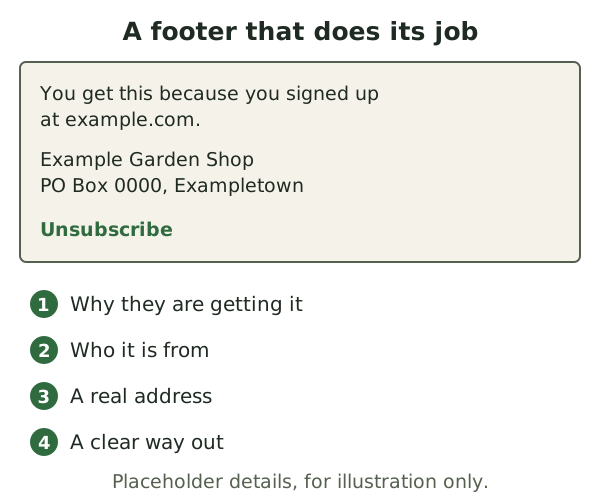
Say who you are
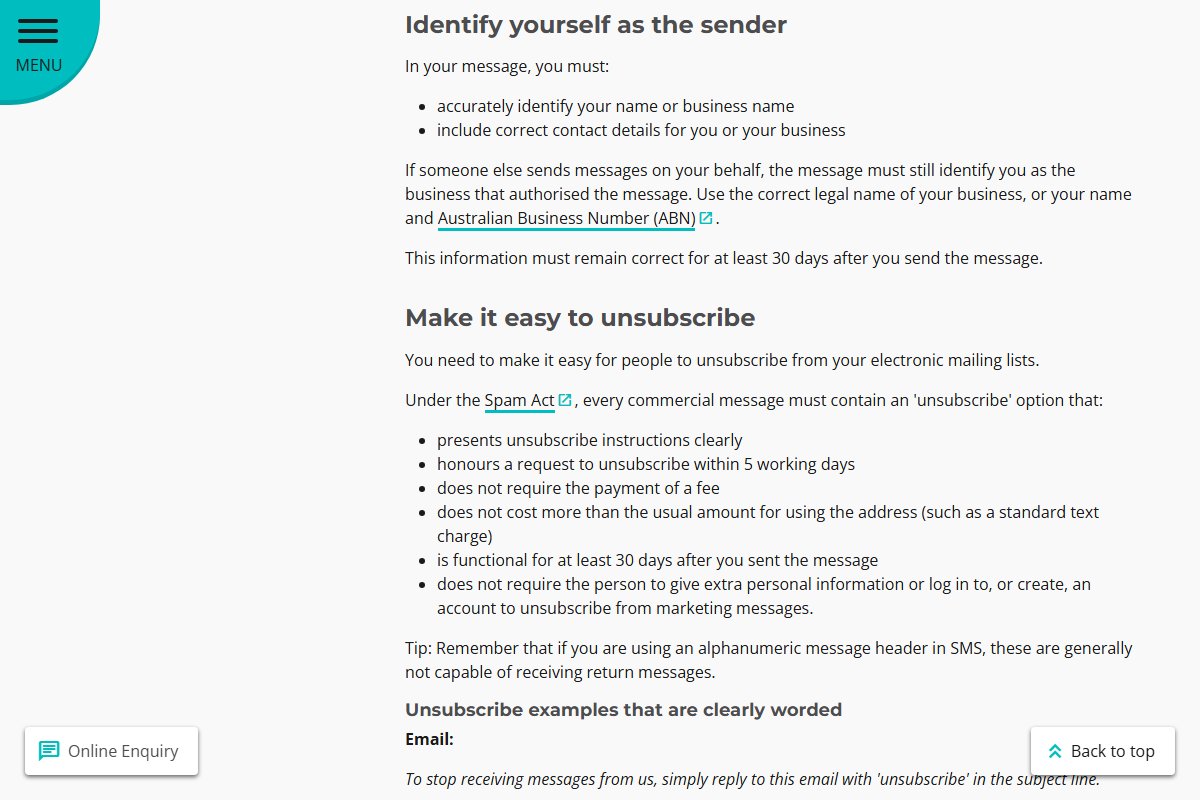
Every email must make clear who sent it. In the US, the from line and other details must be accurate and name the sender.[2] In Australia, you must give your name or business name and correct contact details.[3] Those details must stay correct for at least 30 days after you send.[3]
The UK rules say you must not hide who you are. You must also give a valid address where people can opt out.[4]
If a company sends your emails for you, you are still responsible. The FTC says you can't hand that duty to someone else.[2] ACMA says the same about consent.[3]
A real postal address
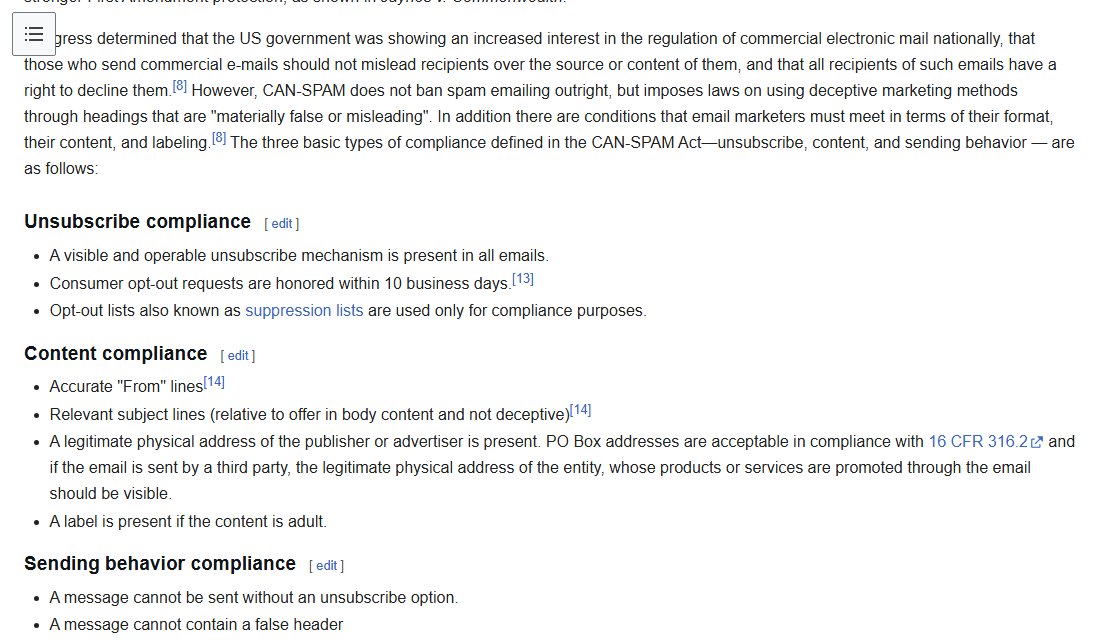
In the US, each marketing email must include a valid postal address.[2] A post office box registered with the US Postal Service is fine.[2] That can keep a home address private.
US law also says a marketing email must make clear that it is an ad.[2] The law gives some freedom in how, but it must be clear.
The unsubscribe link
The way out must be easy to find and easy to understand. Every email needs one that works.[5] The FTC asks for a clear explanation of how to opt out.[2]
Here is what the rules ask of the link itself:
- It must be free. No fee, in the US or in Australia.[2][3]
- No extra details. In the US, you can't ask for more than an email address.[2]
- No login. In Australia, people must not have to log in or create an account.[3]
- It must keep working. At least 30 days after you send, in both countries.[2][3]
You can offer a menu, such as "fewer emails" or "only sales". But in the US, one choice must stop all marketing email.[2]
In the EU, people must be able to withdraw consent at any time. Doing so must be no harder than signing up was.[6] That is a good rule anywhere.
How fast you must act
The law sets deadlines for acting on an unsubscribe.
- United States: within 10 business days.[2][5]
- Australia: within 5 working days.[3]
- Yahoo asks senders to act within 2 days.[7]
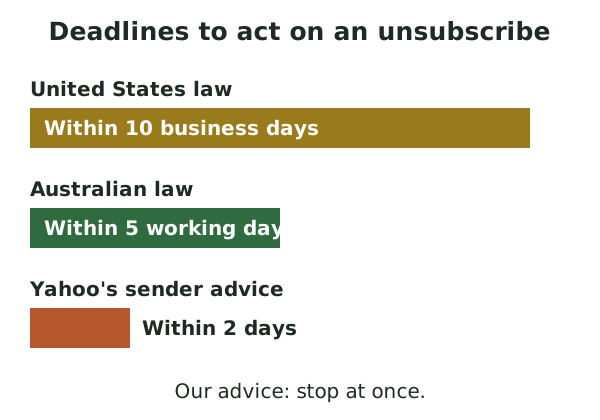
These deadlines are the slowest you may go. Every email after someone leaves feels like you weren't listening. So check that your email tool removes people at once.
The US rules have teeth. Each email that breaks them can cost up to $53,088 in penalties.[2]
One-click unsubscribe
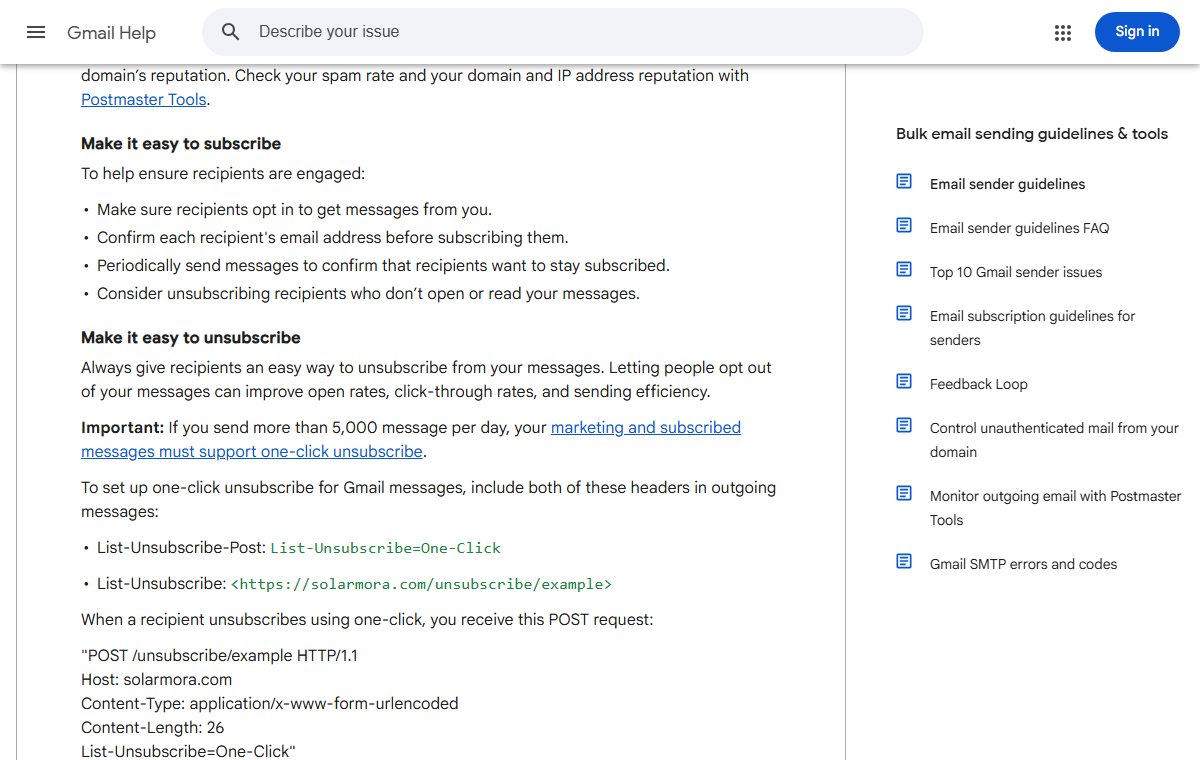
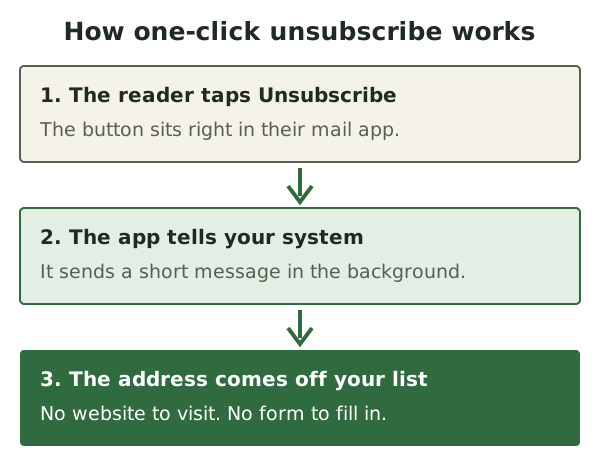
Some mail apps can show their own unsubscribe button, so readers can leave without leaving the app.[8] To support it, your email needs a hidden label called a header. Ask your email tool whether it adds this for you.
Gmail says senders of more than 5,000 messages a day must support one-click unsubscribe.[1] It also wants a clear unsubscribe link in the body of the email.[1] Yahoo asks for the same.[7]
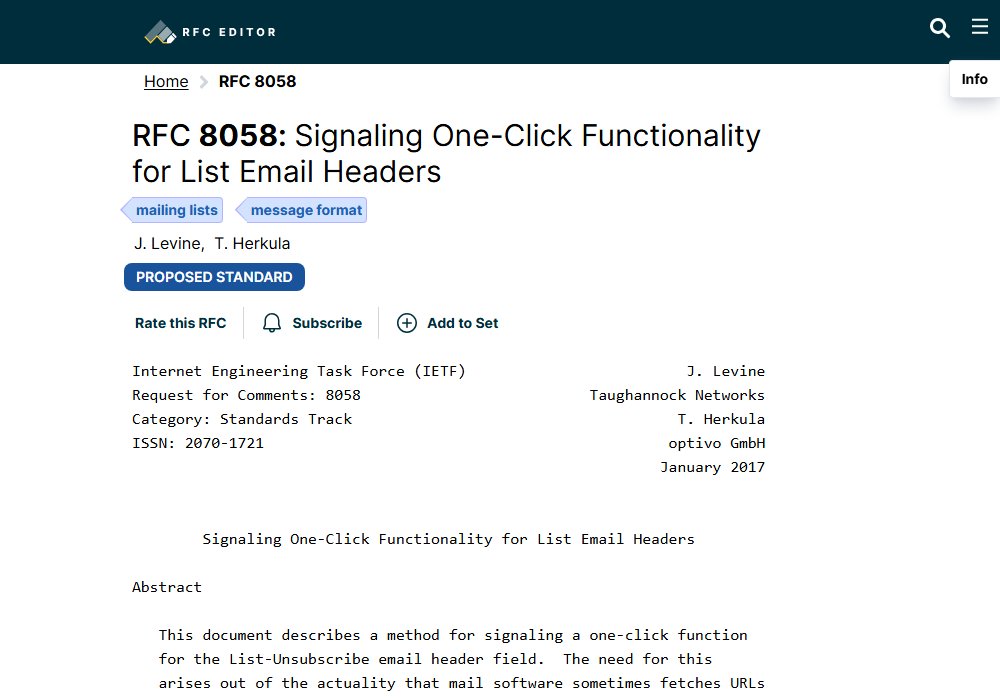
The method comes from a standard called RFC 8058. It lets a mail app signal "unsubscribe" with one tap.[8] The request is handled in the background, with nothing more for the reader to do.[8]
Even if you send far less than that, one-click is worth having. It is the easiest way out, and that protects your name.
After someone leaves
Take them off the list and keep them off. The ICO suggests a "do not contact" list of everyone who has opted out.[4] That way, a later import can't add them back by mistake.
Once someone has opted out in the US, you can't sell or pass on their address.[2]
One more thing: mail providers also check that your email really comes from you. Gmail asks senders to set up email authentication, a kind of digital signature.[1] Your email tool or web host can help with that.
What to do next
Open your last issue and check the footer. Is the sender clear? Is there a postal address? Is the unsubscribe link easy to see and free to use? Then sign up to your own list and test leaving it.
Next, learn which numbers to watch in Reading your numbers.
Sources
- Email sender guidelines, Google (Gmail Help) (accessed 2026-10-18)
- CAN-SPAM Act: A Compliance Guide for Business, US Federal Trade Commission (accessed 2026-10-18)
- Avoid sending spam, Australian Communications and Media Authority (accessed 2026-10-18)
- Electronic mail marketing, UK Information Commissioner's Office (accessed 2026-10-18)
- CAN-SPAM Act of 2003, Wikipedia (accessed 2026-10-18)
- General Data Protection Regulation, Wikipedia (accessed 2026-10-18)
- Sender Best Practices, Yahoo (accessed 2026-10-18)
- RFC 8058: Signaling One-Click Functionality for List Email Headers, IETF (accessed 2026-10-18)